Benefit Delivery Tools for Creators
A ground-up redesign of how creators deliver benefits to their patrons, from fragmented manual workflows to a fully automated system, with a granted patent along the way.

Patreon's top earners were running massive businesses on fragile, manual tools. This project was about closing that gap. We started by shipping targeted improvements that moved the needle, which earned us the trust to pitch a much larger structural overhaul. While company restructuring meant my time ended before I could see Patreon 2.0 fully ship, I'm incredibly proud of the foundation we built. My research defined the core roadmap, and a speculative design for tracking loyalty resulted in my first granted USPTO patent. You can see the full architectural vision in my follow-up Patreon 2.0 case study.
The Product
Patreon is a membership platform where creators offer exclusive content, community access, and perks to paying subscribers. The Creator Tools team owned the systems creators used to configure tiers, set up benefits, and deliver those benefits to the right patrons at the right time.
This project covers two phases of work: an incremental improvement sprint that moved creator satisfaction from 49% to 73%, and a three-week design sprint that reimagined the entire benefit delivery system for Patreon 2.0.
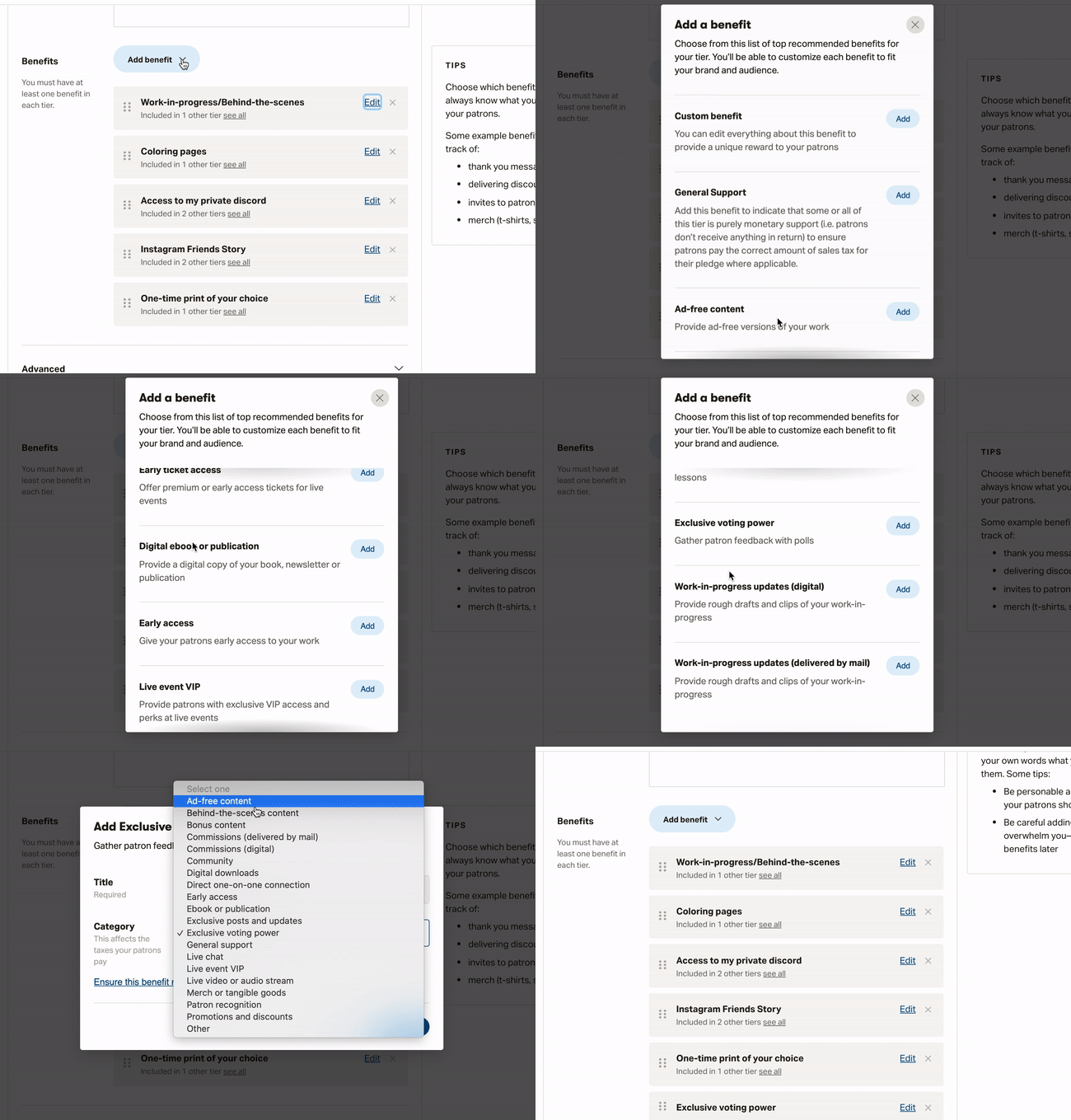
The benefit configuration experience, 28 benefit types, most requiring manual delivery.
The Problem
Patreon's top creators, the Mavens earning above $45k per month, had outgrown the platform's tools. They were running real businesses, managing thousands of patrons across complex tier structures, and the delivery experience was not built for that scale.
Creator satisfaction was at 49% in November 2020. The tools they relied on most were broken or barely used: the Patron Relationship Manager accounted for 38% of all bugs filed, and the Benefit Tracker had just 9.5% active usage. Creators were not ignoring the tools out of habit. They genuinely could not rely on them.
A real creator's subscription page, the level of granularity the platform was expected to support.
The Patron Relationship Manager, responsible for 38% of all bugs filed. Source: Zendesk.
Benefit Tracker active usage at 9.5% as of December 2020. Source: Mode.
Research
A three-week generative research project was run with 12 creators fitting the Maven persona, earnings above $45k per month, identified in partnership with the Data Science team. The goal was to understand how they delivered complex benefits, why they had abandoned the Benefit Tracker, and what tools outside Patreon they relied on to fill the gaps.
Four themes emerged consistently: creators perceived Patreon had stopped innovating; the Benefit Tracker was actively resented, not just ignored; entitlement logic was too tightly coupled to billing status, which was already complicated by multiple billing models; and Patreon was losing ground to platforms like OnlyFans, Clubhouse, and Cameo that moved faster.
Phase 1: Targeted Improvements
Improving creator satisfaction was an OKR for Q4 2020 and Q1 2021. The constraint was real: solutions needed to move meaningful metrics without requiring an application rewrite. The team focused on four targeted changes that collectively closed the gap between what creators needed day-to-day and what the platform actually provided.
- Benefit Tracker Snippet
A lightweight addition that surfaced benefit status directly in context, letting creators quickly check delivery progress and troubleshoot without navigating away. Not a full solution, but a meaningful reduction in friction for a tool that had almost no active users.
Benefit tracker snippet, benefit status surfaced in context.
- Saved Filters
Creators were building the same complex filter combinations repeatedly every session. Saved filter presets eliminated that manual work without requiring a full overhaul of the filtering system. A small intervention with an outsized effect on daily workflow.
Saved filter presets, eliminating repetitive manual filtering work.
Saved filters in action.
- Searchable Note Fields
Creators needed labeling and tagging to manage patron context at scale. Full tagging was too complex to implement in this phase, so note fields were made data-indexable and searchable instead. A technically lightweight change that meaningfully expanded how creators could organize and retrieve patron information.
- Pledge Streak Filter
An invention for representing membership loyalty through payment history visualization. The pledge streak color-codes successful and declined payments over time, giving creators a way to make informed decisions when rewarding benefits, distinguishing genuinely loyal patrons from those with inconsistent payment history. Patreon filed and was granted a USPTO patent for this invention (No. 12,154,126), co-invented with Jennifer Pugh.
Pledge Streak Filter prototype, click through to explore.
Beyond the Brief
Two explorations happened outside the formal scope of Phase 1, driven by problems that surfaced during research and felt worth pursuing even without a direct mandate.
- Audience Chart
Patreon had no way for creators to visualize how their audience was distributed across tiers. This exploration made that visible, showing concentration, drop-off points, and tier health at a glance. Creators responded strongly to it in testing. The Audience Dashboard concept was approved for Patreon 2.0.
- Mobile Benefit Planner
A mobile-first feature concept that grouped patrons into cohorts proactively, with deeper filtering, delivery tracking, messaging, and automation built in. This became the direct foundation for the Phase 2 design sprint.
Audience chart exploration, tier distribution visualization.
Mobile Benefit Planner prototype, the concept that seeded Phase 2.
Phase 1 Impact: Earning the Runway
By February 2021, these targeted interventions successfully moved creator satisfaction from 49% to 73%, hitting our primary OKR. More importantly, this short-term win proved that reducing operational friction had an immediate positive effect on our top earners.
Fixing the immediate bleeding earned the Creator Tools team the organizational trust and runway needed to pitch a much larger structural overhaul. The research insights and speculative prototypes from this phase became the catalyst for securing executive buy-in to invest heavily in a full 2.0 redesign.
Phase 2: Patreon 2.0 Design Sprint
With executive backing secured, a three-week product design sprint was run to reimagine benefit delivery from scratch. The goal was a fully automated experience that blurred the line between creating content and delivering benefits, and made room for new monetization channels beyond subscriptions. The outcomes of this sprint became the foundation for a larger Patreon 2.0 initiative covered separately.
The sprint covered five touchpoints: creation, configuration, qualification, delivery, and patron-side consumption. All 28 benefit types were regrouped into 7 color-coded categories to reduce cognitive overhead. The core insight that emerged was that content and benefits are the same thing. Posting exclusive backstage footage and configuring a live event benefit are structurally identical interactions. That realization became a central design principle for Patreon 2.0.
28 benefit types regrouped into 7 categories, color-coded to reduce cognitive load.
Benefit creation and qualification flow, one-time events, flexible monetization, and pledge streak integration.
Automation confirmation screens, making it explicit that delivery is handled by the system.
Creator feed concept, content, benefits, and merch store as distinct but connected surfaces.
Prototypes
Round 1 prototype, initial benefit delivery system concept.
Round 2 prototype, refined after user testing. Click through to explore.
Walkthrough of the Round 2 prototype and research findings.
Research Findings
Benefit categorization tested positively across both rounds. Users understood the seven categories and knew what to expect within each with minimal guidance. The biggest conceptual shift: content and benefits are the same thing. Posting exclusive footage and configuring a live event benefit are structurally identical interactions. That insight became a central design principle for Patreon 2.0.
Automation was understood and trusted when made explicit. Creators needed to see what the system had taken over, not just that it had. The merch store one-off purchase model felt immediately familiar, and loyalty gamification through the pledge streak felt natural. Physical goods shipping remained manual. The team aligned on supporting it but not automating it without robust e-commerce integrations in place first.
Launch and Tradeoffs
Phase 1 improvements shipped across Q4 2020 and Q1 2021 within tight engineering constraints. The cohorts feature was designed but did not ship, the predefined condition logic required backend work that fell outside scope.
The Phase 2 sprint secured executive buy-in and resources for the 2.0 build. Shortly after, company-wide restructuring impacted my team. The architecture established here served as the foundational blueprint for what followed. Benefit modularity was a deliberate choice: all seven categories were designed as independent modules so the 2.0 implementation could roll them out selectively. NFTs were explored as an alternative monetization channel during the sprint given the timing. That direction was not prioritized for the 2.0 roadmap.
Impact
Phase 1 improvements moved creator satisfaction from 49% to 73% within three months. The pledge streak filter resulted in a granted USPTO patent (No. 12,154,126), co-invented with Jennifer Pugh. The Phase 2 sprint secured the organizational alignment and resources needed to move forward, giving the team a clear architectural foundation to build from.