
Inspire Tab
Led the Smart Home vertical on Amazon Inspire, owning the ranking strategy, feed CX, and creator tooling that made device discovery trustworthy at scale.

Recommendations in the Smart Home category have to be accurate. A badly informed purchase erodes trust in the entire discovery surface. I owned the interaction patterns, content strategy, and the ranking logic I built with data science. My background from Patreon and Prox made the creator side natural because I had a clear understanding on how creators think about monetization and audience.
Inspire was Amazon's TikTok-style shopping feed, built inside the main app. Photo and video content from influencers and verified buyers, all shoppable. I led the Smart Home Devices vertical: the interaction system, what surfaces in the feed and how, and the creator tooling, a space I knew well from Patreon and building Prox.
Smart Home is not a category you can rank by engagement alone. A customer buying the wrong smart bulb because a video looked good is a trust problem, not a conversion win. The feed needed to know device type, ecosystem compatibility, and customer context before surfacing anything.
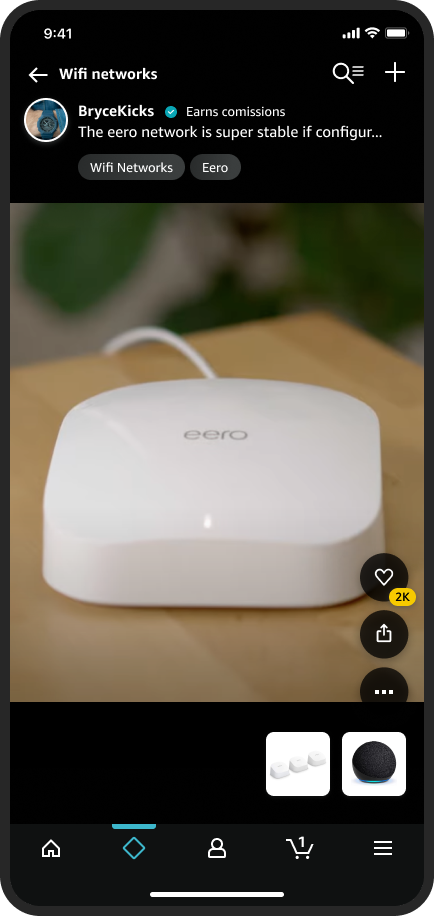
Interactive prototype for the Smart Home Devices vertical on Amazon Inspire.
The Problem
While for most categories, optimizing for engagement generally worked, for Smart Home, a bad recommendation had severe implications. To show the customer relevant products, the ML ranking needed to account for device type, ecosystem compatibility, and customer context/ownership.
Strategy
I worked with data science to shape how Smart Home taxonomy fed into ranking. Compatibility and device type signals had to carry real weight in the algorithm. On the surface, I owned the CX decisions that determined how device content read at feed speed.
Interaction System
I designed the full interaction spec across five distinct views: landing, two sub-feed states, and two tag-drilled states. Each has its own navigation behavior, back-stack rules, and configurable layout variables.
Tag navigation drives the sub-feed architecture. Some concepts explored testing tag placement at top vs. bottom of screen.
Feed architecture across five views: landing, sub-feed landing, sub-feed immersive, and tag-drilled states.
Component Specs
I documented each component interaction states. The main container responds to swipe up/down and tap to toggle chrome. Product thumbnails scroll as carousels and tap to a quick view sheet. Video controls appear only when media type is video.
Basic interactions spec: component anatomy, gesture map, and chrome behavior for the main feed view.
Creator text truncates to one line by default. Tapping expands in an overlay. When text is scrolling, gesture zones split: inside scrolls the description, outside advances to the next piece of content. That required explicit touch area documentation to hand off without ambiguity.
Creator lockup expanded state: touch areas and behavior when navigating away and returning.
Gesture zone logic for scrolling vs. non-scrolling text states.
Creator and Reviewer Trust System
Two distinct content types, different trust signals. Verified creators show a blue checkmark, Earns Commissions label, and link to a creator storefront. CGC reviewers show star rating, verified purchase status, and link to a customer profile.
Tapping Earns Commissions triggers a bottom sheet disclosure. I designed this flow to meet the requirement without interrupting the shopping experience.
Earns Commissions disclosure flow: trigger, bottom sheet, and handoff to Amazon Influencer Program.
Working with Creators
Amazon has the Influencer Program. And this feature amplified their revenue stream. The opportunity for creators was a direct commission path on one of the highest-traffic shopping surfaces in the world. I designed the tooling that let them attach products to content, structure their offers, and identify their top sellers. In sessions with creator partners, the work was helping them treat the feature as a storytelling opportunity and build content around what was actually converting.
Creator tool flow: ASIN attachment and product association controls.
Impact
At Amazon's device sales volume, a 2.5% lift represents roughly 13.5M units.
On the creator side, Amazon Influencer commissions range from 1% to 10% per sale, with dedicated creators earning $1,000 to $5,000+ per month. Our top creators saw measurable income growth after we restructured how they attached products to content.
Inspire was deprecated in early 2024 as Amazon shifted toward conversational search. The interaction system and creator tooling informed how the org approached catalog integrity on later projects.