
Image Builder
Built an internal tool for Amazon Devices, enabling non-designers to create production-ready marketing campaigns across 23 marketplaces through image and localized copy generation, eliminating dependency on graphic designers.



Role
Lead UX Designer
Timeline
September 2024 to February 2025
Team
PM, 6 Engineers, Brand Studio

This creative tool gave marketers total control of content creation, at scale. Didn't want to create design tools for them. Instead, my team encoded brand guidelines, localization rules, and production constraints directly into the product through PNG files of devices, backgrounds, and logos. Amazon has a well-defined set of templates, and this engine, at first, assembled them while being cautious of aspect ratios, spacing, and composition.
Eventually, it evolved into assembling images and copy with the Amazon voice, in multiple languages. Proud of contributing new interaction patterns to our global design system that has my signature on it.
The Problem
Creating a single campaign required designers, copywriters, translators, and marketing operations. Amazon served 23 marketplaces and up to 5 language variations on each. Before Image Builder, each marketing team was responsible for their asset generation, composition, and copywriting/translation, and leadership wanted to move away from that.
The challenge was giving hundreds of non-designers the ability to publish to Amazon.com while being completely error proof. Eg: promoting a product unavailable in a region, displaying incorrect currencies, wrong translations, or product leaks.
The shipped product. Select markets, dimensions, background, device, and logo. Copy generation and translation are automatic.
The System
Image Builder gave marketers a friendly but constrained workspace. Users chose a background, selected a product composition, configured their marketplaces, and added a logo. The platform generated localized copy, assembled device compositions, resized layouts, validated market compatibility, and exported production-ready assets.
The interface I designed deliberately exposed very little. Guardrails were set up based on information gathered from Brand Studio, legal, and localization teams, and the beauty behind it is that users didn't need to learn or correct the rules.
Illustration of how Image Builder composed promotional assets in layers. Each layer carried metadata that established guardrails and enabled automated image generation, localization, and validation.
One campaign, multiple formats. Users configured the content once, while Image Builder adapted it across different layouts automatically.
Device compositions assembled automatically. Previously a Photoshop task, now part of the same flow.
Eventually, Image Builder didn't just assemble the visuals. It also generated promotional copy with AI for every selected marketplace, while still allowing regeneration and manual edits whenever needed.
Design
When you look at the interface, I sincerely think I didn't design anything groundbreaking. In fact, the hardest part of the project wasn't designing the interface. It was making it lean, scalable, and deciding which design decisions users should never have to make.
Had to adapt Amazon's never-ending set of templates. And as the platform expanded across 23 marketplaces, multiple device families, and dozens of campaign formats, the challenge shifted from editing images to managing complexity.
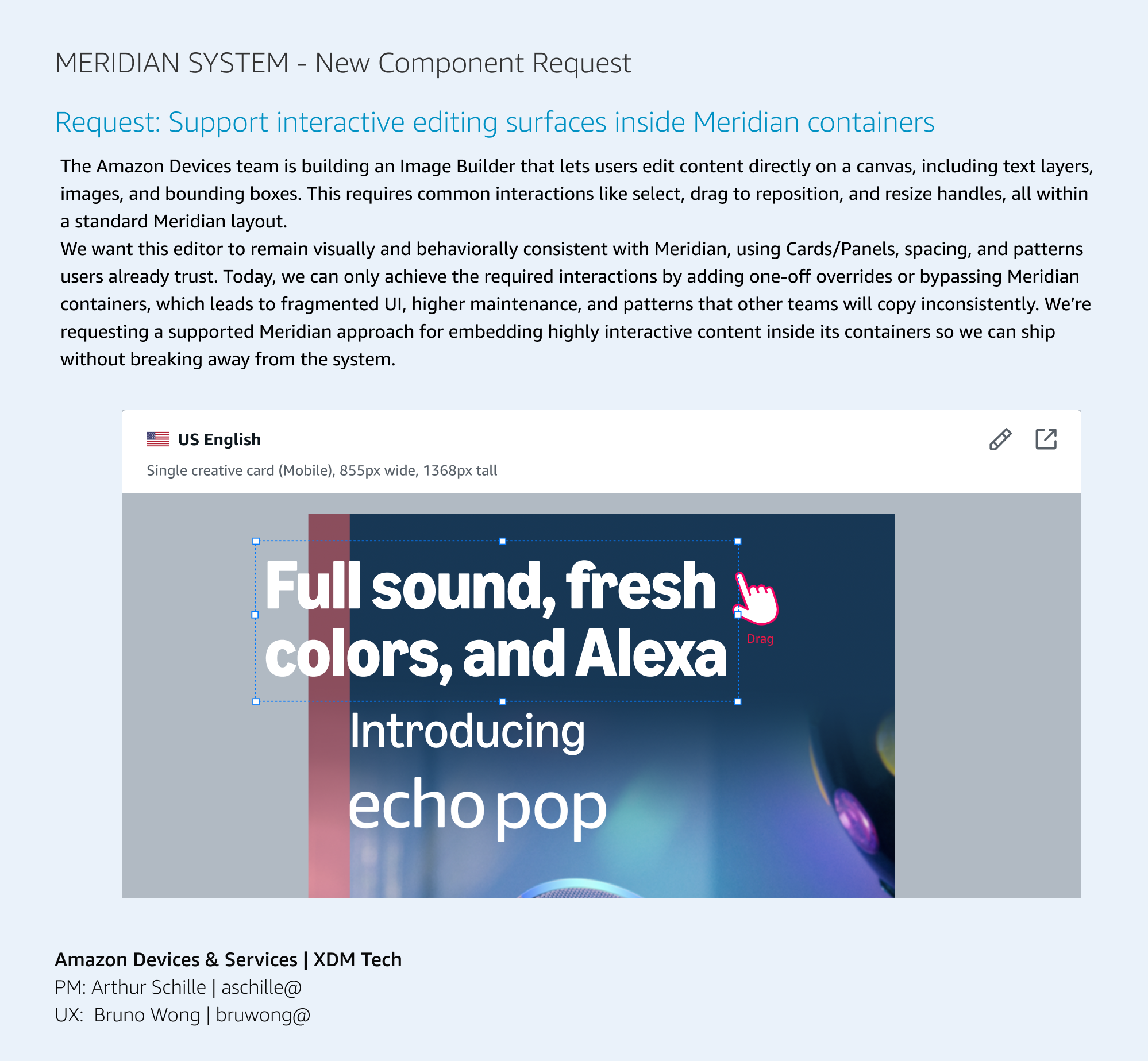
Along the way, I stumbled upon design system walls and contributed three components back to Meridian, Amazon's internal design system: an interactive editing canvas, a multi-select locale filter, and a reusable validation state.
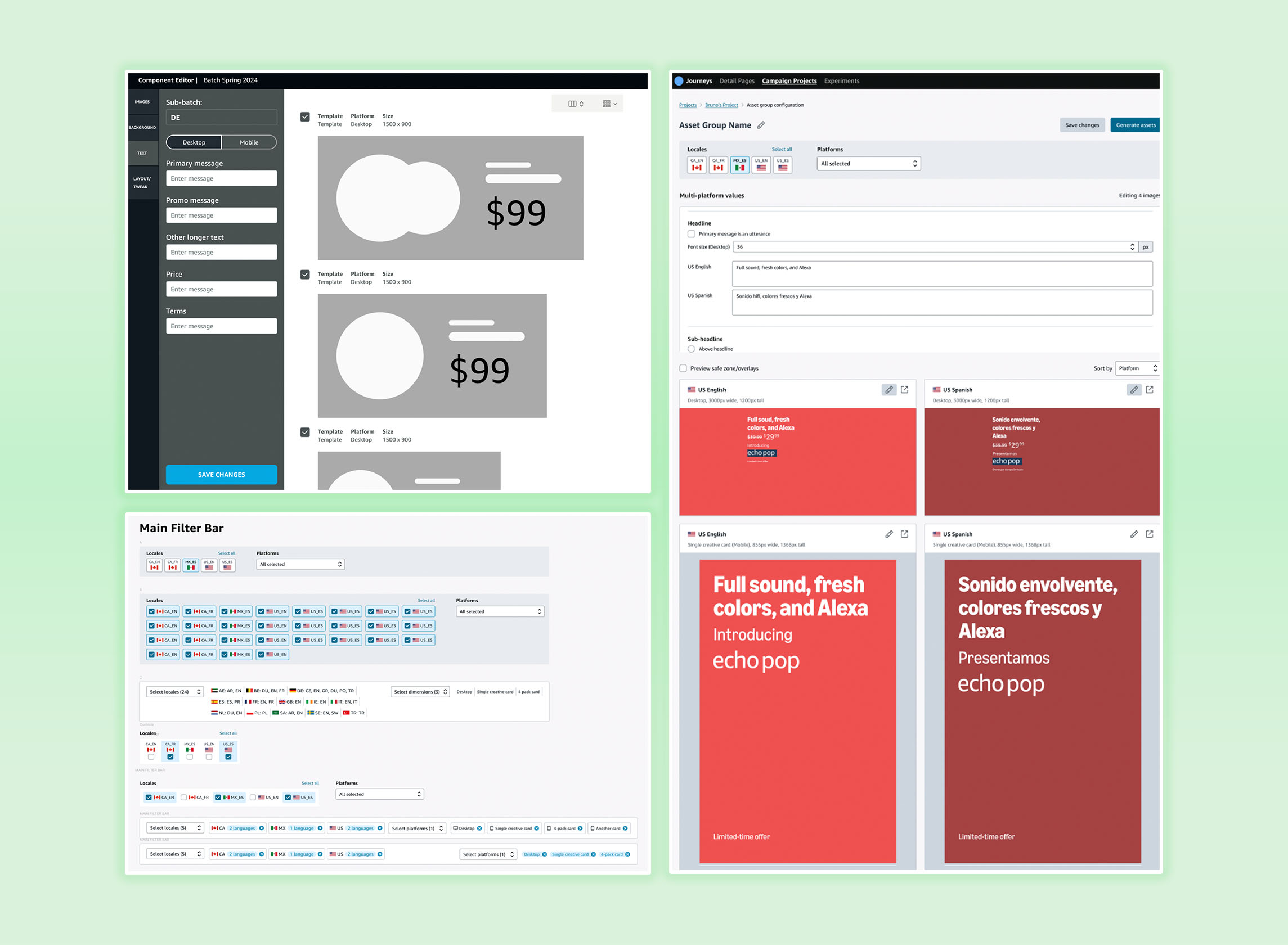
Structuring multi-market configuration so the interface stayed clear regardless of how many combinations were active.
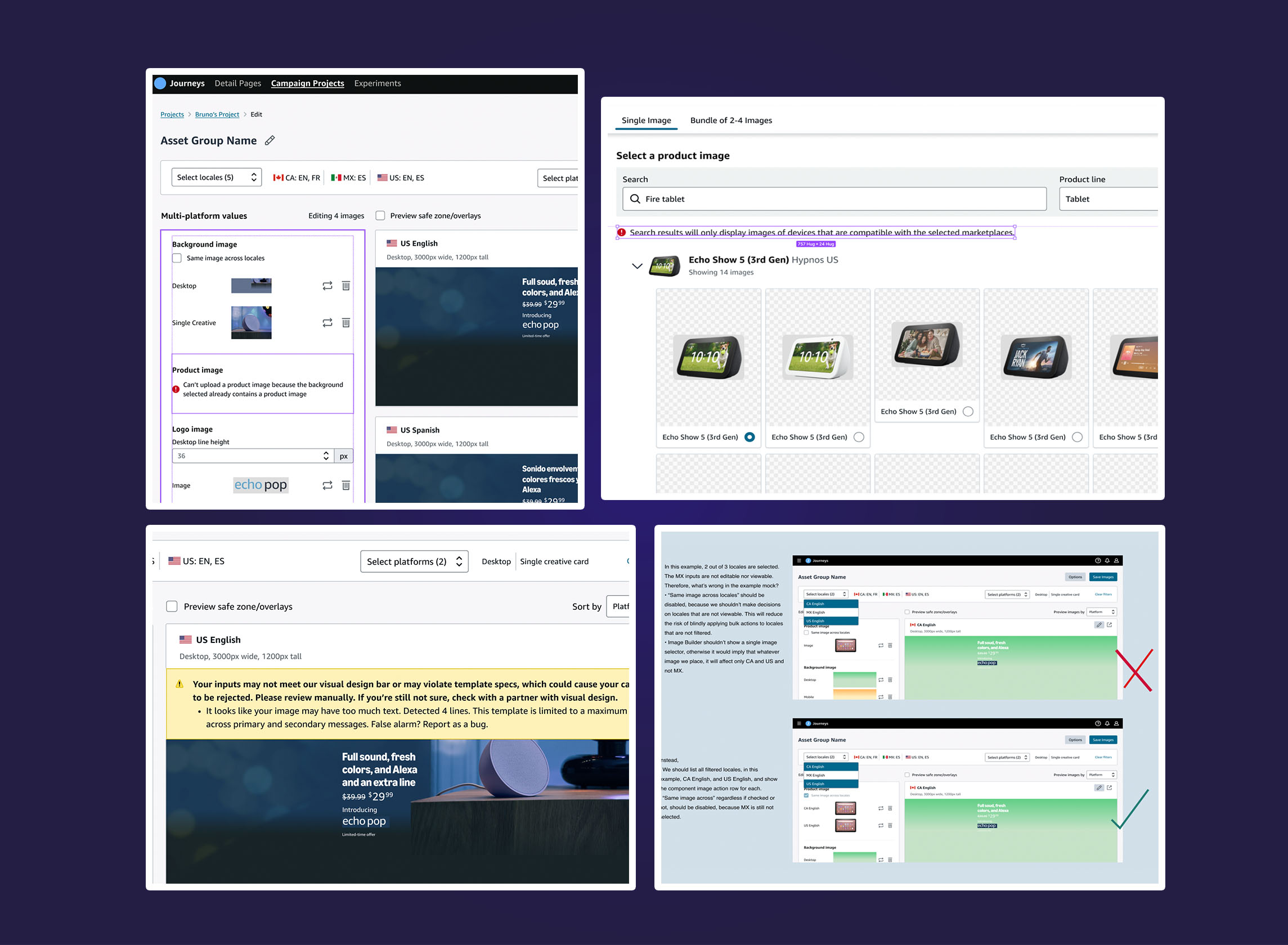
Export validation caught regional conflicts and spec violations before images reached a reviewer.
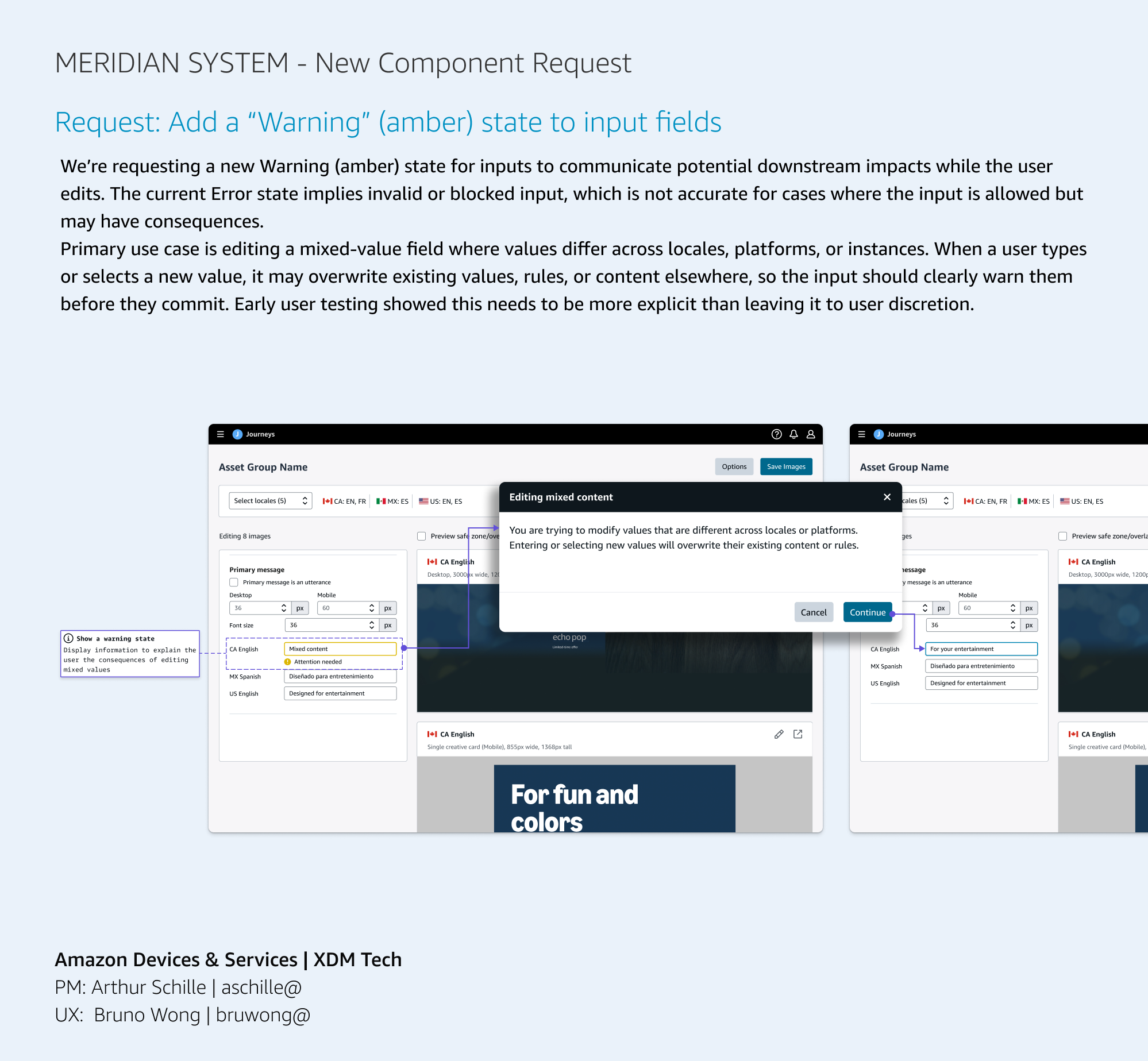
Interactive editing canvas. Built for Image Builder, contributed to Amazons design system.
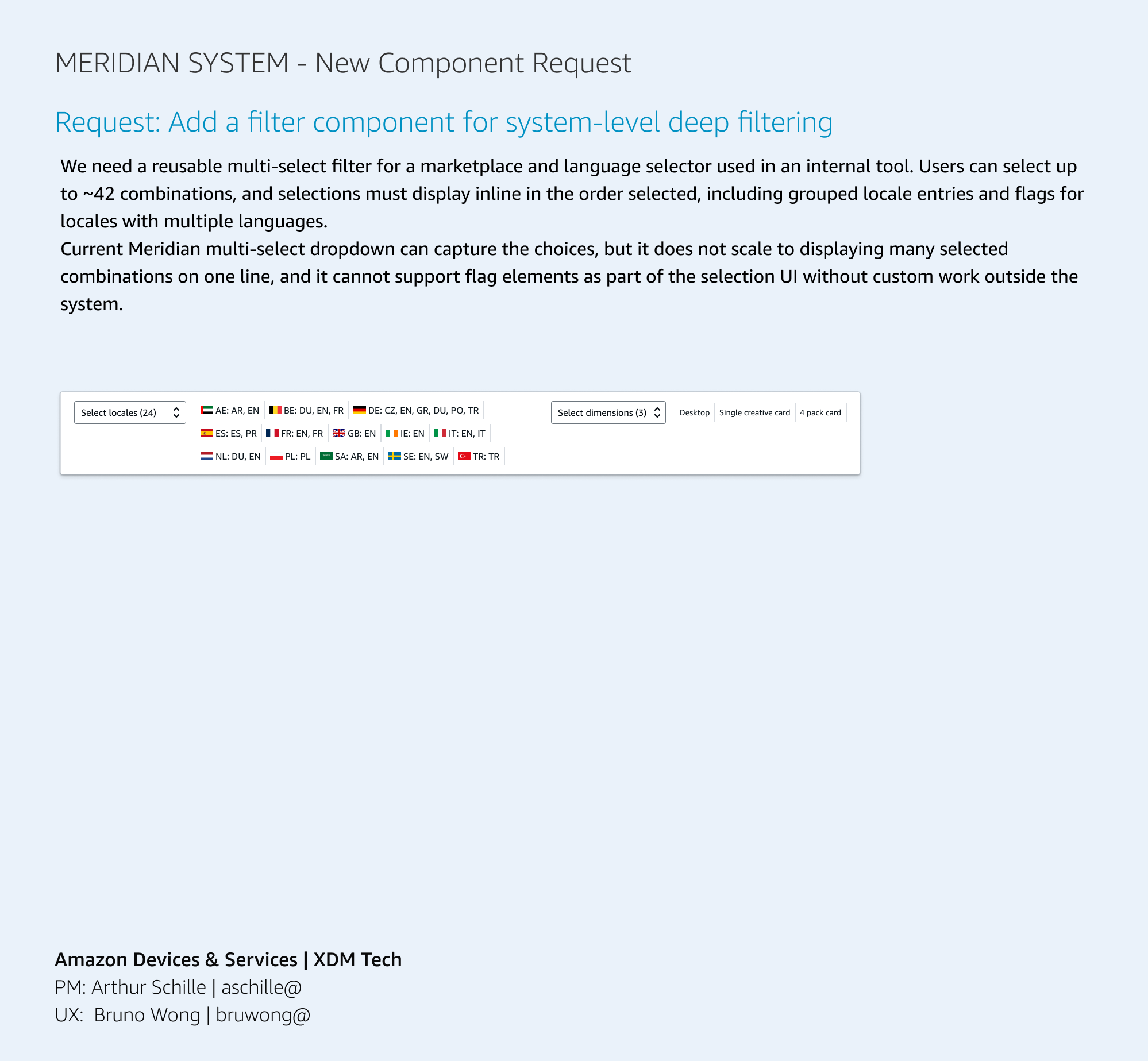
Multi-select locale filter. Handles 23-market combinations in a compact control.
Warning input state. Flags export-blocking issues inline instead of at a final validation step.
Launch & Iteration
After 3 months of deep dive, we launched a version of the Image Builder that supported our 2 most converting banner formats. We did it to maximize business impact and user adoption. At the same time, had to make compromises in the product, like, umm, no drag & dropping. Different formats required different configuration models, and users immediately pushed against the limits of fixed layouts. We intentionally postponed drag-and-drop editing to meet the launch window.
By Prime Day, 4 months post-release, we had incrementally improved the interaction model and the platform had expanded across all supported campaign formats.
Result
~8,000 campaign assets generated for Prime Day 2025. ~48,000 hours of production work eliminated for a single event. 45–50 FTE of operational capacity freed across creative, localization, and marketing operations.
The success of Image Builder secured continued investment in the broader Amazon Devices Asset System, expanding the platform into asset governance, AI-assisted metadata, and automated lifestyle image generation.