
Alto Pharmacy Internal Tools
A redesigned internal platform that helped a pharmacy operations team resolve patient requests faster, with less friction and fewer workarounds.

Alto was scaling fast, but the internal tools hadn't kept up. Pharmacists and care specialists were stitching together Wunderbar, Marcia Notes, Notion, spreadsheets, and Slack just to resolve a single patient request. The system worked, but it placed the burden on people instead of the product. The goal was to change that: surface the right context, reduce the time it took to act, and give the team tools that matched how they actually worked. The most honest outcome was an MVP that improved Marcia Notes and got action cards onto the roadmap, with a North Star that aligned the org around where to go next.
The Product
Alto Assistant is an internal platform built to help Care Specialists resolve patient requests faster and with more confidence. The work centered on Wunderbar, Alto's operational backbone, and its legacy messaging interface, Marcia Notes.
Wunderbar and Marcia Notes, Alto's internal pharmacy operating system.
The Problem
By 2021, internal teams were navigating a fragmented toolchain, Wunderbar, Marcia Notes, Notion, spreadsheets, and Slack, just to complete day-to-day work. The system wasn't broken. It just didn't help users understand what mattered, what needed action, or how to resolve a task confidently. That gap increased handling time, slowed onboarding, and eroded trust in the tools.
The fragmented toolchain teams were navigating to complete a single task.
Goals
Three priorities shaped the direction: improve first-contact resolution so Care Specialists could act without follow-up; reduce time to resolution while preserving the ability to handle complex cross-functional cases; and maintain a consistent patient experience without relying on heroics or external coordination tools.
Alto also lacked reliable instrumentation to track metrics like first-contact resolution or time-to-resolution, actions weren't clearly structured in the system, so none of it was measurable yet. Establishing that baseline became part of the work.
Research
The team ran foundational research alongside early wireframe testing to identify which capabilities a redesigned system would actually need. Twelve usability sessions were conducted with pharmacists and operations staff across departments, tenure levels, and seniority.
Prototype flows used during usability testing, click through to explore.
Usability session recording, observing a Care Specialist working through the existing system.
Sessions surfaced four consistent patterns: deep distrust in the existing system; confusion around prioritization and urgency; the realization that message threading wasn't the core issue, patients shifted topics freely and enforcing structure added friction; and strong early reactions to action-based patterns, where creating actions directly from messages consistently outperformed abstract task lists.
Conversation Model
Defining what a 'conversation' meant inside the system was a systems problem that had to be solved before any interface work could begin. The model that emerged treated conversations as time-bound sessions based on activity, not topic completion, with patients able to shift freely between subjects. That definition became the foundation every design decision was built on.
Design Explorations
- Action-First Patterns
The first direction tested generating operational actions directly from patient messages and resolving them within context. Action-first patterns aligned with how internal teams already thought about their work, reducing context switching and making progress visible. Early testing reactions were strong across the board.
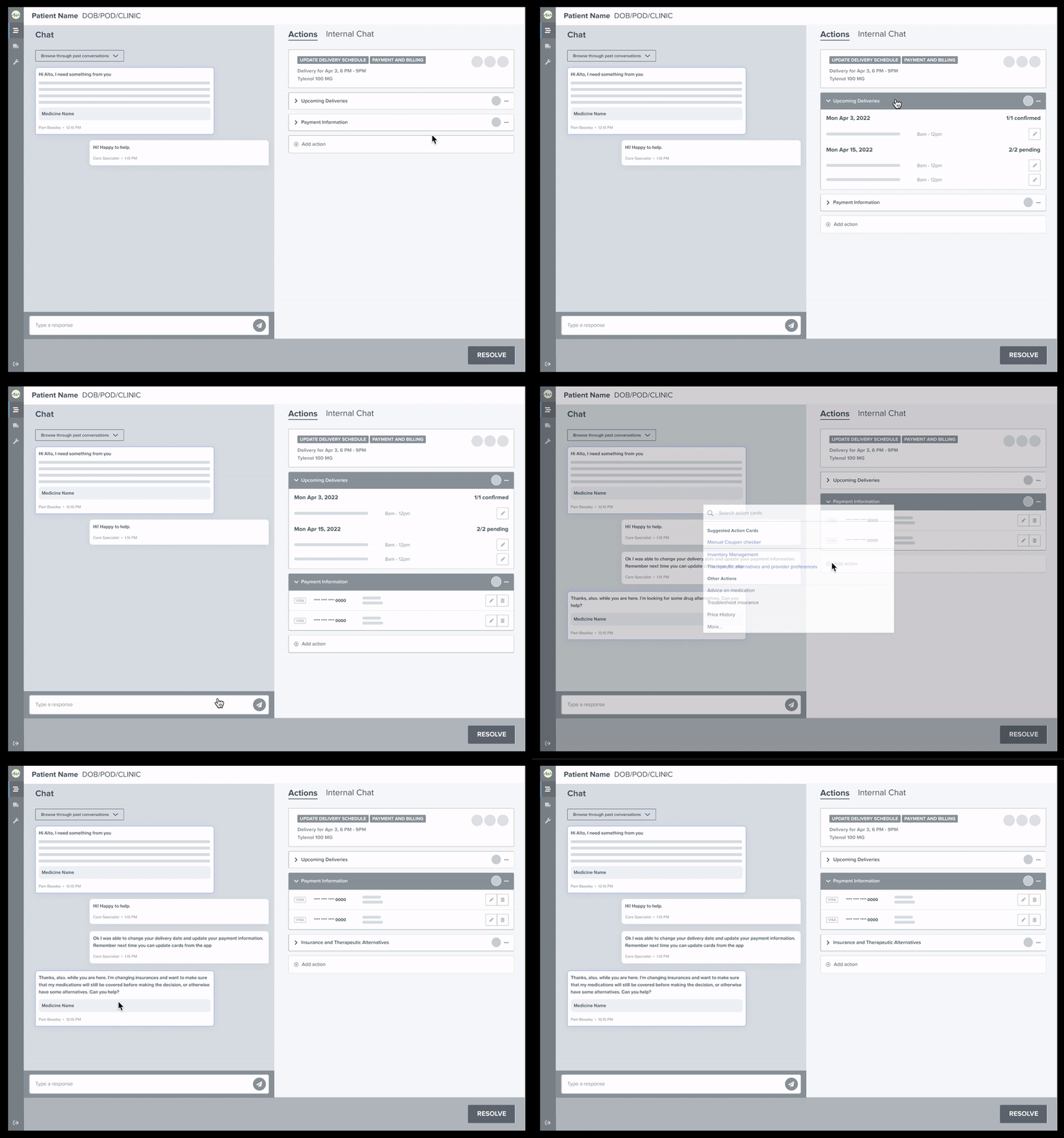
Action cards: creating and resolving actions directly within a patient conversation.
Turning a patient message into a structured action without leaving the conversation view.
Programmable responses, templated replies to reduce time on common patient communications.
Action card system, a structured format for surfacing, tracking, and resolving patient requests.
Anatomy of an action card.
- Contextual Stacking
These explorations tested keeping actions visually close to message history, stacking them beneath or alongside conversations. Borrowing familiar patterns reduced friction and helped users maintain context, though long scroll depth remained a concern in complex cases.
Marcia Notes, improved, refining the existing interface with better context and visual hierarchy.
Full vertical layout, actions stacked in sequence with the conversation.
A real patient message sequence sent within a five-minute window.
- Structural Rethinking
The third direction questioned whether conversations and actions needed to share the same view at all. These explorations tested thread-based models and multi-panel layouts that separated message history from operational work, trading familiarity for greater structural clarity at scale.
How a simple message could become a structured thread.
Triple panel view, separating conversation, context, and action into distinct workspaces.
Direction & Tradeoffs
The design direction focused on keeping actions tightly coupled to conversation context, not restructuring conversations or enforcing threading, but prioritizing clarity and fast action creation within existing workflows. Action-based patterns consistently resonated in reviews with Care Ops leadership, product, and engineering. Larger structural changes raised concerns around complexity, training cost, and delivery risk.
Two constraints shaped the final scope: the system still lacked instrumentation to forecast impact, and engineering capacity limited how much could be rebuilt. The team aligned on an incremental approach, improving Marcia Notes while deferring larger structural changes.
MVP & North Star
MVP: a refactored Marcia Notes with improved context, hierarchy, and inline action creation.
North Star: dynamic action cards adapting to patient context alongside the conversation view.
MVP scope mapping, what shipped, what was deferred, and how each decision mapped to the North Star.
Launch & Tradeoffs
The full North Star didn't ship. Internal tooling improvements consistently lost the resource prioritization argument to patient-facing features with clearer business cases. What did move forward were the workflows with more legible operational ROI: billing improvements and patient case handling inside the Alto app, both of which had measurable downstream effects on cost per shipment.
Marcia Notes was refactored and stabilized. Not the structural overhaul the research pointed toward, but a real improvement to the baseline: better context, clearer hierarchy, and reduced reliance on external tools for common tasks.
The 18% reduction in communications per shipment was real and measurable. The team lacked the instrumentation to tie it directly to a cost-per-shipment figure for internal tooling specifically. The dollar outcome, Care CPS dropping from $16 to $10, is covered in the Alto Assistant case study, which addresses the patient-facing side of the same system. The action cards concept and North Star direction were approved and added to the roadmap before my time there ended.
Impact
Communications per shipment dropped 18% compared to control groups, falling below 1.0 for the first time in July 2022. The internal tooling work was one side of the same system: while the patient-facing app reduced inbound volume, these improvements ensured Care Specialists could handle what remained faster and with less friction.