Alto Assistant App
A full-service digital pharmacy app covering prescriptions, payments, insurance savings, and human pharmacist care, redesigned around patient confidence and clarity, reducing per-order costs by $2.

Alto was building something genuinely different in a category that had resisted change for decades. The product touches nearly every part of a patient's relationship with their medication, from insurance and fulfillment to talking directly with a pharmacist. The work on Alto Assistant was about making that experience feel less like a transaction and more like being taken care of. Designing for clarity and confidence in a medical context is harder than it sounds. Patients are often anxious, the stakes are real, and the operational constraints are tight. The $2 per-order reduction was real and measurable, but the more important outcome was that patients felt guided rather than processed. That is what the design was actually trying to do.
The Product
Alto is a full-service digital pharmacy covering prescriptions, payments, insurance savings, fulfillment, and direct pharmacist care. Alto Assistant is the patient-facing layer inside the mobile app where patients ask questions, report concerns, and request help. This project focused on medical questions: the most expensive, most complex, and most clinically sensitive category of inbound message.
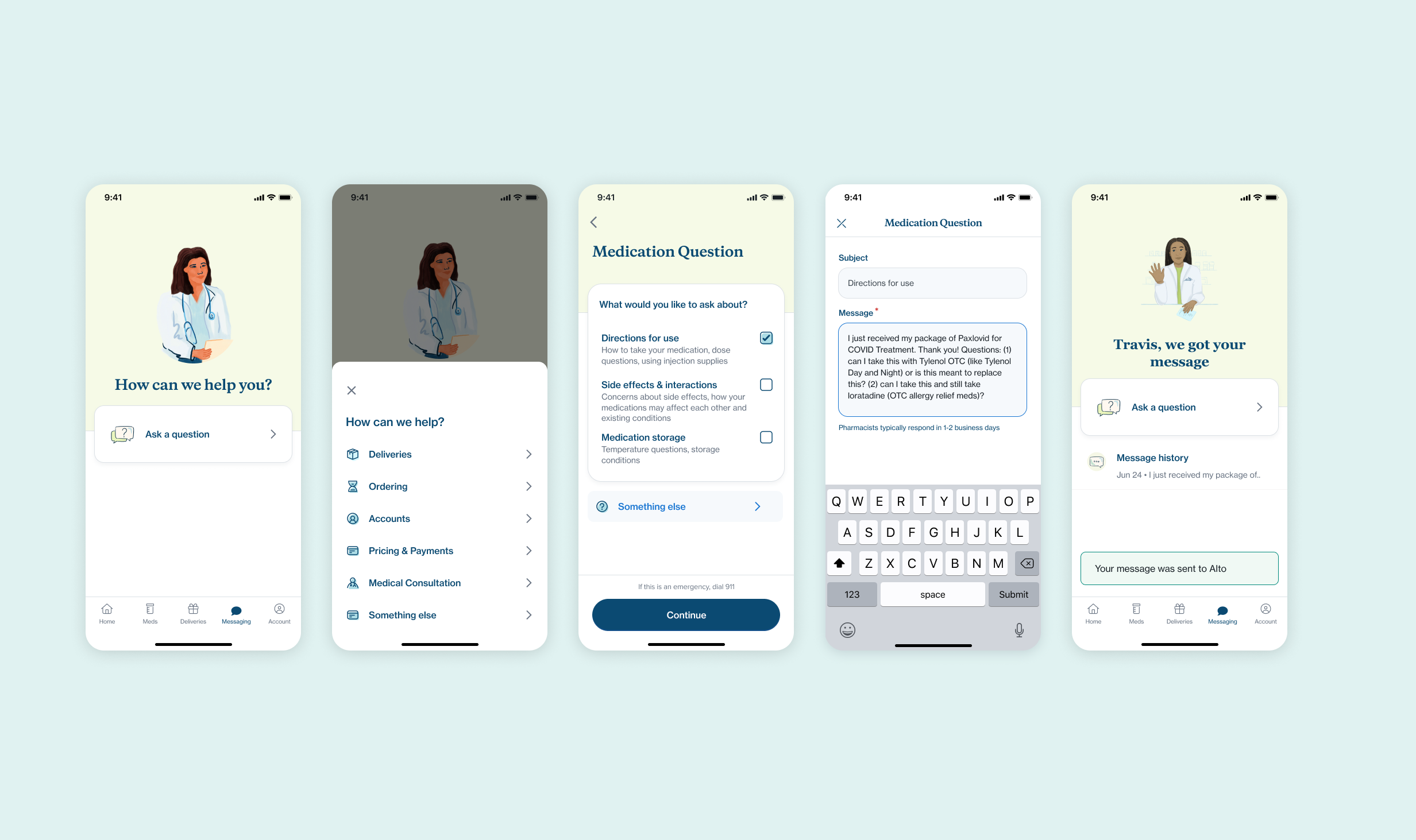
Alto Assistant, the shipped patient messaging experience.
The Problem
In 2022, Alto's mobile app received an average of 3,200 patient messages per day, each one generating a support ticket. Many were non-clinical or resolvable through self-service, but all of them required Care Ops to triage. Medical questions required pharmacist involvement on top of that. At Alto's shipment volume, every dollar of unnecessary handling cost added up fast.
Messages arrived as unstructured text with no context, no categorization, and no expectation setting. Care Specialists spent time triaging messages that didn't need them. Pharmacists handled expensive escalations without enough upfront context. Patients were left uncertain about response times and next steps.
The business had a clear target: reduce Care Cost per Shipment from $16 to $10. Medical questions were the most expensive category, each escalation required a Care Specialist and then a Specialty Pharmacist, often duplicating effort across handoffs.
The unstructured message entry point, no context, no routing, no expectation setting.
Goals
Three priorities shaped the work. Reduce Care Cost per Shipment by decreasing unnecessary inbound messages. Limit avoidable escalations to pharmacists through better upfront context. And set clearer expectations for patients around response time and next steps.
For patients, the goal was simpler: make it easier to ask a medical question confidently, understand what happens next, and get qualified help without unnecessary back-and-forth.
After auditing a week of inbound messages, the team grouped them into six core topics. That bucketing made it possible to tackle each problem independently. This case study focuses on medical questions, the most operationally expensive category.
Six message categories identified from the inbound audit, each with a distinct operational profile.
Research
Research surfaced a consistent tension between patient uncertainty and internal operational risk. Patients often didn't know how to frame medical questions, frequently raised more than one concern at a time, and defaulted to messaging as a catch-all. Internally, Care Ops and Pharmacy worried about being overwhelmed by unfiltered volume or becoming bottlenecks when escalations spiked.
Those findings made one thing clear: asking patients to self-diagnose or pick the right category would add friction and undermine trust. The solution needed to guide without gatekeeping.
Research synthesis: patient uncertainty mapped against internal operational constraints.
Usability session, patients working through medical question flows.
Early Explorations
Before narrowing into specific interaction patterns, the team explored a wide range of visual and structural directions to understand how guidance, tone, hierarchy, and information density could affect patient confidence.
Visual exploration covering tone, hierarchy, and interaction density.
Validation
As concepts narrowed, two variants were tested with 9 patients to pressure-test the boundary between operational efficiency and patient trust.
- Option A: Minimal structure
Routed patients more directly to pharmacists. Operationally efficient, but surfaced concerns around clarity and expectation setting. Users often assumed the interaction would be synchronous and were uncertain about response timing.
Minimal structure variant, direct routing with limited guidance.
- Option B: Lightweight guidance
Added a medication-focused step to help patients frame their question and set clearer expectations. Slightly more complex, but users found it more reassuring, with fewer mismatched expectations about what would happen next.
Lightweight guidance variant, medication context step with expectation setting.
Testing confirmed that small interventions could meaningfully improve clarity. A recurring theme also emerged: several patients wanted to see relevant medication information immediately, a capability that already existed in the app but was hard to discover. That insight shaped the North Star direction.
Design Explorations
Three directions were developed and reviewed with Product, Pharmacy, and Care Ops leadership. Each explored a different balance between structure, flexibility, and clinical risk.
- Option 1: Medication context first
Start with medication selection to anchor the question. Gave the system immediate routing context and helped patients frame their concern around a specific medication rather than a general symptom.
Option 1: medication context anchors the question from the start.
- Option 2: Multi-medication support
Allowed patients to raise questions about multiple medications in a single session. More flexible and closer to real patient behavior, but introduced meaningful complexity in routing and Care Specialist triage.
Option 2: multiple medications and questions in a single flow.
- Option 3: Guided subtopics
Medication selected first, then guided through relevant subtopics. The most structured of the three. Produced the richest upstream context but added the most steps, raising concerns about drop-off and access for patients with complex or ambiguous questions.
Option 3: medication first, then guided through relevant subtopics.
View all three options in detail, click through to explore.
Direct to Pharmacist
One specific flow explored during this phase was a direct-to-pharmacist routing path for high-confidence medical questions. The goal was to eliminate the Care Ops handoff entirely for cases where pharmacist involvement was clearly required from the start.
Direct-to-pharmacist routing, bypassing Care Ops for clearly clinical questions.
What Shipped
A full redesign of the medical questions flow didn't ship during this phase. What did ship were targeted improvements to how Care Specialists handled patient conversations inside Wunderbar, alongside patient-facing flow improvements that launched in May 2022 to a 10% controlled cohort.
The exploratory work aligned Product, Care Ops, and Pharmacy around shared principles for future iteration, creating clarity on what a safer, more scalable system could look like when instrumentation and resourcing allowed.
Shipped state: the medical question flow as it went live in May 2022.
Care Specialist view, improved context and message clarity inside Wunderbar.
North Star
The longer-term vision anchored the medical consultation journey around a medication selector, with clearer guidance, relevant subtopics, and self-service content layered on top. Patients would get help faster and with better context. The system would reduce unnecessary back-and-forth and downstream escalations. Several patients had surfaced this direction during testing, they wanted relevant medication information immediately, and the capability existed in the app but was too hard to find.
North Star: a medication-anchored consultation experience with integrated self-service content.
Launch
The feature launched in May 2022 following a 10% controlled cohort rollout, in line with Alto's release protocol for medical-context changes. The cohort allowed the team to monitor behavior and validate impact before full release. This case study shares platform-level metrics with the Alto Internal Tools work. Both were part of the same Alto Assistant system, the patient-facing and internal-facing sides of the same operational problem.
Impact
Per-order shipping costs dropped by approximately ~$2, a direct result of reducing unnecessary inbound message volume by 38% and cutting the escalations that required both Care Ops and Specialty Pharmacist time. Care Cost per Shipment fell from $16 to approximately $10 over the course of the project. The platform served 11,000+ internal users across 30,000+ weekly visits, preventing a significant volume of unstructured messages from entering the care queue.